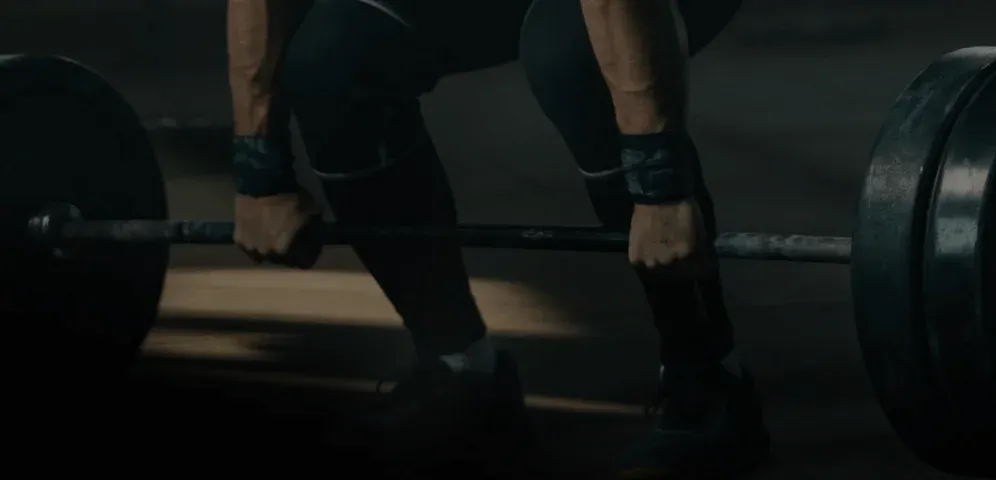
How to deadlift properly? Above all, do not round your back
The deadlift is one of the best exercises to strengthen your whole back. Learn how to deadlift properly so your technique stays safe and mistake-free.
The deadlift is a fundamental strength exercise. We call it a pull, but in reality we are pushing – the lift is performed by driving your hamstrings and glutes into the floor, which is what raises the weight. It is a highly functional and effective movement, because in everyday life we often lift a load off the ground all the way up to standing.
We do not even realise it, but we often perform these movements incorrectly, for instance when carrying a washing machine, a wardrobe or similar heavy loads. Our back may be rounded and unbraced, which can lead to injury.
This exercise works every muscle group, but we never pull with the lower back, because we could overload it and hurt ourselves.
How to deadlift properly
- both feet are flat on the floor, roughly hip-width apart
- your hands are on the outside of your legs so they touch them but do not get in the way; that way you pull the bar upwards along the shortest path, close to your body
- your arms stay straight throughout the whole deadlift; bending them can injure your biceps or tendons
- your back is in a neutral position and your head is an extension of your spine. Do not lean back at the top, because hyperextension can hurt your lower back
- push your diaphragm down and breathe into your belly to brace your core – the back does not pull the weight, it is under tension, and we never want it rounded and unbraced
- as you drive, engage your hamstrings and glutes and keep your whole body tight; at the top, tuck your pelvis under and keep your shoulders set
- the way down (the negative phase) mirrors the way up. It is good to control the bar all the way until it is back on the floor.
- breathe in at the top or on the way down. As you drive up, hold your breath and exhale as you move into extension – roughly as the bar passes your knees on the way to standing tall
How to grip the bar
A standard double-overhand grip is harder, but it trains your grip better. A mixed grip, with one palm facing away from you and the other towards you, helps you “lock in” to the bar, so you can lift a heavier weight. To avoid developing imbalances, it is a good idea to switch the grip between sets.
There are many kinds of deadlift. The most common variations include:
Romanian deadlift – you do not take the bar all the way to the floor; you push your hips further back, stop at the bottom when your hamstrings are under the most tension and come back up.
Sumo deadlift – the feet are wide and you grip the bar narrow between your legs. Because the stance is wide, the bar travels a shorter path, and compared with the conventional deadlift you use more of your quads and glutes.
Trap bar deadlift – a technically easier variation of the deadlift; it loads the lower back less, which is an advantage for people with spine problems.
Do not forget unilateral exercises (working one side of the body). Single-leg deadlifts with dumbbells or kettlebells can help you, among other things, even out imbalances. Good alternatives to deadlifts also include good mornings and hip thrusts.
The deadlift is a great exercise that everyone can and should do. If for whatever reason you cannot perform the full movement, the solution is to break it into parts you can manage, raise the bar off the floor to shorten the range of motion, or pick the deadlift alternative that suits you best. After your deadlift session, do not forget quality nutritional supplements for athletes, BCAA for faster recovery and joint nutrition, to keep your knees and other joints 100 % healthy.
Read also: We reveal what works for muscle soreness after training!