How to squat properly?
Want to learn proper squat technique? Read how to squat with your bodyweight or under load, and which mistakes to avoid.
Squats are one of the most versatile exercises: a loaded squat, for example, works not just the legs but practically the whole body. Anyone can do them, they need no equipment at all, and they can be adapted to your needs and imbalances. So how do you do them?
How to do a bodyweight squat
- Stance is shoulder-width. Individually, somewhere between hip and shoulder width.
- Toes are turned slightly outwards. Feet stay flat on the floor the whole time.
- The spine is in a neutral (straight) position.
- Start the movement by hinging at the hips (pushing them slightly back), then begin the descent, driving the knees outwards, in line with the feet.
- In the bottom position the hips are below knee level. Squat depth depends on the individual's mobility and flexibility. But never chase depth at the expense of a straight back.
- Drive upwards by pushing the glutes and hamstrings into the floor and finish in full extension.
- Breathe into the belly, push the diaphragm down and brace the core.
- Inhale at the top, hold the breath, and exhale as you drive up into extension.
Front, back, loaded
You can also squat with a dumbbell or a kettlebell. A good variation is the goblet squat, which can help with hip mobility and lets us squat better with an upright torso.
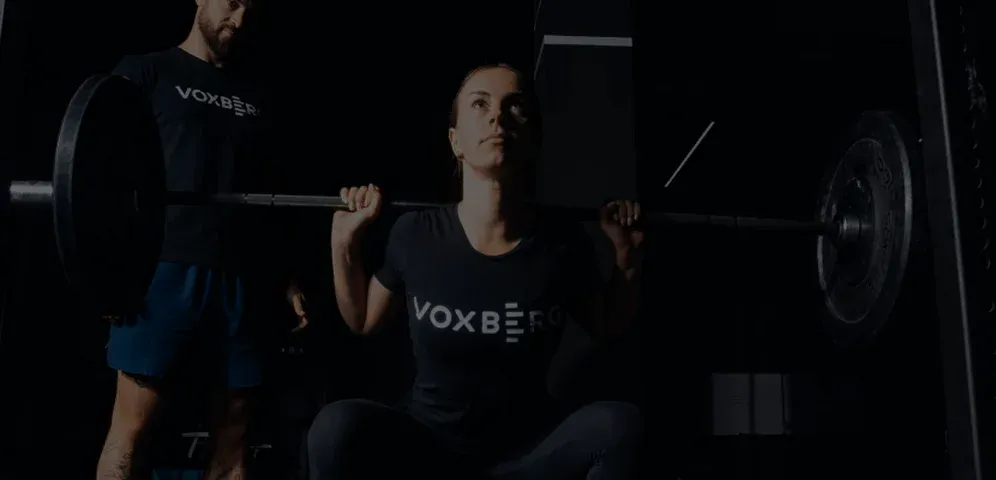
When it comes to barbell squats, we distinguish back squats and front squats – named, correctly, after the position of the bar. In a front squat we hold the weight of the bar mainly with the abs and the core. Back squats hit mainly the hamstrings, glutes and lower back. If you squat heavy, don't forget nutrition for your joints.
Back squats are further divided into high bar squats and low bar squats. In the high bar squat the bar sits on top of the shoulders, and these are also called Olympic squats. The torso is more upright and you can get a little deeper in the squat.
In the low bar squat the bar sits a little lower, below the shoulders on the shoulder blades. These are called powerlifting squats, so you'll use them more in powerlifting. Here the hamstrings, glutes and lower back do more of the work.
In weightlifting there is also the overhead squat, but that is a very demanding movement for people with mobility issues, especially in the shoulders.
Single-leg squats are another excellent variation – for example Bulgarian split squats, which are a superb unilateral exercise that helps us with imbalances.
After squatting, don't forget a quality protein and BCAAs for faster recovery.
The most common squat mistakes
On every rep and every set, keep in mind how not to do this:
- Knees caving inwards – make sure they track in the same direction as your toes, and don't just drop with the weight. Give yourself a few seconds of controlled movement and you won't get hurt.
- Rounded back – if you breathe into your belly properly, you'll keep a solid core and help your spine stay neutral. We don't want to bend the back into flexion, but not into hyperextension either.
- Heels lifting off the floor – the upward drive comes from the legs and glutes. And you can't do that without your heels on the floor. Load less weight and work on your technique.
Read also: How and what to eat without gaining weight at Christmas? Christmas Eve can be a moderate evening