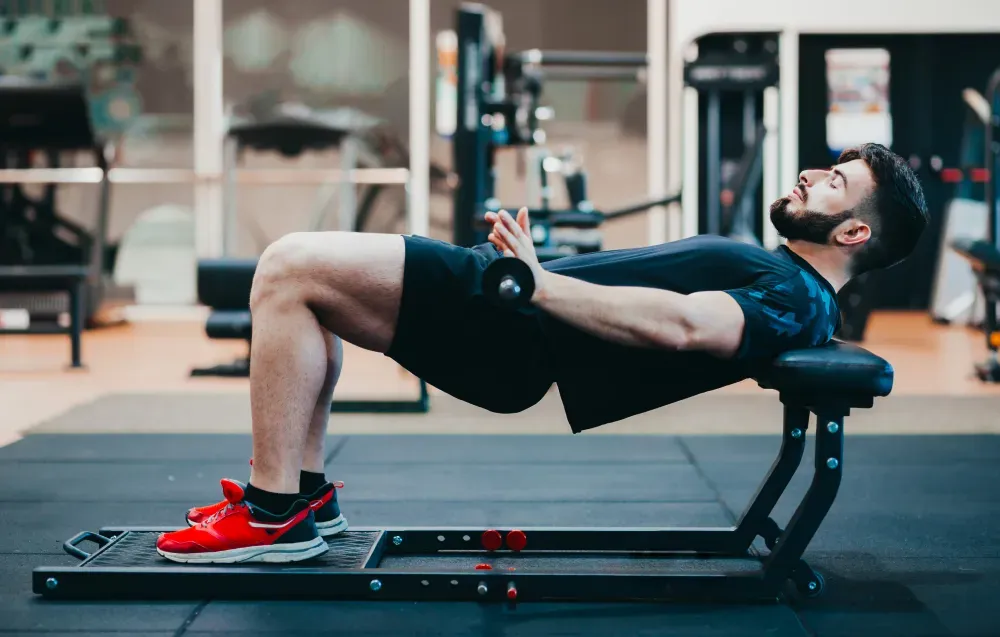
How to do the hip thrust correctly and avoid injury
Not sure how high the bench should be, if your back is in a good position or how wide your feet should be? You're in the right place.
Hip thrusts are an excellent exercise for building absolute strength and strengthening your glutes and hamstrings. As with every exercise, there are a few principles you need to watch out for so you perform it correctly and keep the risk of injury to a minimum. We'll also show you how not to do it.
The correct body position for the hip thrust
- The bench should sit just below knee height.
- Keep your feet roughly shoulder-width apart, just like in a squat, with your toes turned slightly outwards if you like.
- At the top of the movement your knees should be above your ankles and in line with your feet.
- Your upper body is braced against the bench.
- Your spine must stay in a neutral position at all times – don't arch or bend to either side.
How to perform the exercise
- In the bottom position, take a breath in, then move into extension (driving up to the top position) as you breathe out.
- As you drive up to the top position, engage your hamstrings and glutes while keeping your spine in a neutral position.
- Stabilise your core with correct breathing technique – breathe into your belly, pushing your diaphragm downwards.
- At the top you want your hamstrings and glutes contracted, your pelvis tucked under, your spine still neutral and your abs braced too. Your hips are above your knees.
- Your head is tilted slightly forward – look straight ahead of you, not up at the ceiling.
- The negative phase (the movement downwards) should be controlled, not just a loose drop to the floor.
What not to do during hip thrusts
Now that you know how it's done, let's go through the most common mistakes. People set the bench either too low or too high. And with poor foot and body positioning, you won't engage the right muscles. When your feet are too close to the platform, you tend to use mainly your quads to drive the movement – but what we want is to engage the hamstrings and glutes.
If your core is loose, your back can drop into hyperextension or, conversely, into flexion. Also watch out for hyperextension at the top of the movement or while driving up.
What sets and reps should you use for the hip thrust?
The hip thrust can be trained on its own or in supersets as part of a strength session. The number of reps per set depends on your goal. If you want to build strength, set your sets at 4 to 8 reps, which will let you go heavier. If your goal is hypertrophy (increasing muscle volume), you can set your sets at 8–15 reps with a lighter weight.
If you've got hip thrusts in your session, you don't need to do squats or deadlifts in the same workout, as they work the same muscle groups.
Read also: First aid for a pulled muscle and how to prevent one